


If you’ve ever smelled gas in your home or dealt with a malfunctioning appliance, you know how quickly things can go from inconvenient to dangerous. A potential gas issue is not just disruptive. It creates immediate safety risks for your home and everyone in it. In those moments, not knowing what to do or where to go can make an already stressful situation even worse.
At Eco Plumbers, Electricians, and HVAC Technicians, we’ve helped thousands of homeowners handle gas-related emergencies, appliance failures, and safety concerns. We’ve seen firsthand how often people are unsure of where their shut-off valves are or how to safely use them when it matters most.
Knowing exactly how to shut off your gas, whether to your whole house or a single appliance, can make all the difference. In this guide, you’ll learn when shutting off your gas is necessary, where to find the right valves, and the step-by-step actions to take so you can respond quickly and confidently when it matters most.
Add Your Heading Text Here
Why Knowing How to Shut Off Gas Matters
Being able to shut off your gas supply quickly can prevent fires, explosions, and serious health risks.
Natural gas is highly flammable, and even a small leak can escalate quickly if not addressed immediately. Acting fast is critical, but knowing when to act is just as important.
There are several situations where shutting off your gas may be necessary:
- You smell rotten eggs, which is a common sign of a gas leak
- An appliance is malfunctioning or not operating safely
- You are repairing or replacing a gas-powered appliance
- Your gas lines have been damaged due to construction, weather, or other external factors
In each of these scenarios, shutting off the gas is a proactive step that can significantly reduce risk and protect your home.
Signs You May Need to Shut Off Your Gas
Before diving into how to shut off your gas, it is just as important to understand when you should take action.
If you notice any of the following warning signs, you should be prepared to shut off your gas immediately:
- A strong sulfur or rotten egg smell
- Hissing or whistling sounds near gas lines
- Dead or dying vegetation around a gas line
- Physical symptoms such as dizziness, nausea, or headaches
- Unusual appliance behavior, like weak flames or soot buildup
These signs often indicate a gas leak or unsafe condition that should never be ignored.
If you suspect a major leak, leave your home immediately and move to a safe distance. Once you are clear, contact emergency services or your gas company right away. Do not try to locate the source of the leak or fix the issue yourself.
Where Is the Gas Shut-Off Valve Located?
Your ability to act quickly depends on knowing where your shut-off valves are before an issue occurs.
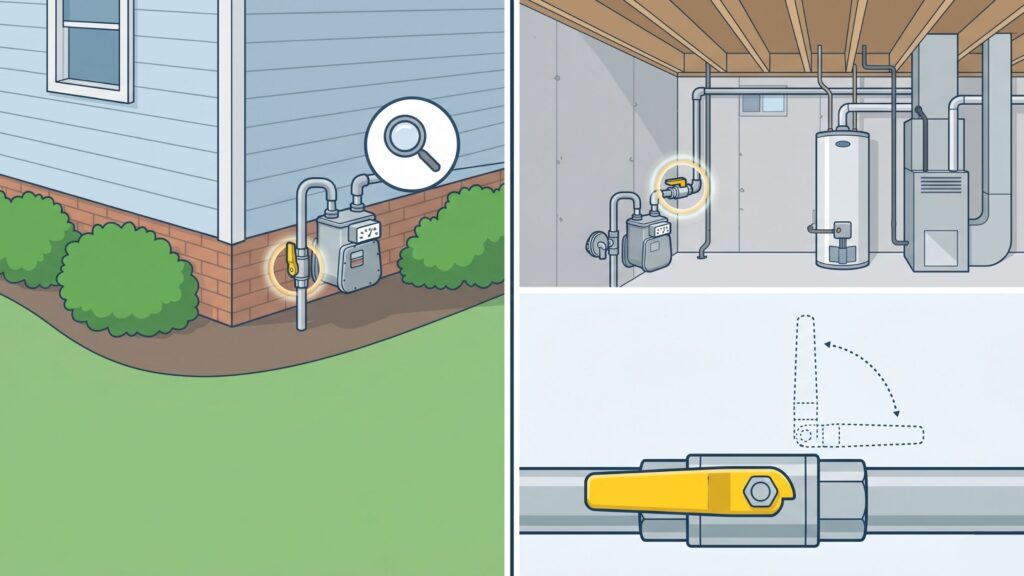
The main gas shut-off valve for your entire home is typically located outside near your gas meter, often along an exterior wall. In some homes, it may also be found in a basement or utility area. This valve is usually a rectangular knob or lever attached directly to the gas pipe, making it easy to identify once you know what to look for.
In addition to the main valve, individual appliances each have their own shut-off valves. These smaller valves are located close to the appliance itself, such as behind or beside a stove, near a water heater, next to a furnace or boiler, or behind a gas-powered dryer.
Knowing where both your main and appliance-specific valves are allows you to respond appropriately, whether you need to shut off gas to your entire home or isolate a single issue without disrupting everything.
How to Shut Off Gas to Your Entire House
Shutting off your home’s main gas supply is a straightforward process, but it needs to be done carefully and correctly.
Step-by-Step Instructions
- Locate your gas meter
This is usually found outside your home along an exterior wall. - Find the main shut-off valve
Look for a rectangular tab or lever on the pipe leading into the meter. - Use a wrench if needed
Some valves can be turned by hand, but others require a wrench for proper control. - Turn the valve 90 degrees
Rotate the valve a quarter turn until it is perpendicular to the pipe. This indicates the gas is fully shut off. - Do not turn the gas back on yourself
Restoring gas service typically requires a professional to ensure everything is safe and functioning properly.
Once the gas is shut off, leave it off until a qualified professional or your gas utility provider confirms it is safe to restore service.
How to Shut Off Gas to Individual Appliances
If the issue is isolated, shutting off gas to a single appliance is often the safest and most practical solution.
Step-by-Step Instructions
- Locate the appliance shut-off valve
This is typically a small lever or knob located on the gas line near the appliance. - Turn the valve perpendicular to the pipe
Rotating the valve 90 degrees will stop the flow of gas to that specific appliance. - Test the appliance
Make sure it no longer receives gas and does not operate. - Schedule repairs if needed
Do not attempt to use the appliance again until it has been properly inspected and fixed.
This approach allows you to isolate the issue while keeping the rest of your home running normally.
Should You Shut Off Gas Yourself or Call a Professional?
This is where many homeowners hesitate, and for good reason. Knowing your role in the moment is critical.
Shut Off The Gas Yourself If… | Call a Professional If… |
You smell gas and need to act quickly | You suspect or have confirmed a major leak |
You’re isolating a specific appliance issue | You’re unsure what you’re doing |
You’ve been instructed to do so by a professional | Repairs are needed |
When it comes to gas safety, your role is to act quickly in the moment, but not to handle the problem entirely on your own. Knowing when to step in and when to call a professional ensures you protect both your home and your safety.
Pro Tips for Gas Safety at Home
Staying prepared ahead of time is what allows you to act quickly and confidently in an emergency.
To reduce risk and improve response time, make sure you:
- Label your shut-off valves so they are easy to identify at a glance
- Keep a wrench near your gas meter so you are not searching for tools in an emergency
- Install carbon monoxide detectors throughout your home for added protection
- Schedule regular inspections of your gas appliances to catch issues early
- Educate everyone in your household on basic emergency procedures
Preparation is what turns a potentially dangerous situation into one you can manage with confidence.
Be Prepared to Act, and Know When to Step Back
At the end of the day, gas issues can quickly go from minor concerns to serious safety risks, especially when you are not sure how to respond. That uncertainty is what leaves many homeowners feeling stuck in critical moments.
Now, you know exactly how to shut off gas to your home or individual appliances, where to find the right valves, and when it is appropriate to take action yourself versus calling a professional. With this knowledge, you are better prepared to protect your home and act quickly when it matters most.
Your next step is to make sure you are fully prepared before an emergency happens. If you are unsure where your shut-off valves are or want peace of mind that your system is safe, schedule a professional inspection with Eco Plumbers, Electricians, and HVAC Technicians. Our team can walk you through your system, ensure everything is up to code, and help you feel confident in any situation.
Because when it comes to gas safety, preparation is not optional. It is essential.
FAQs
Can I turn my gas back on myself?
In most cases, no. Utility companies and safety guidelines typically require a licensed professional to restore gas service to ensure there are no leaks and all appliances are operating safely.
How long can my gas stay off?
There is no strict time limit, but your system will need to be properly inspected when it is turned back on. A professional will also need to safely relight any pilot lights and check for issues.
Is it safe to shut off the gas without tools?
Some shut-off valves can be turned by hand, but many require a wrench for proper control. Keeping the right tool nearby ensures you can act quickly when needed.
What does the valve position mean?
The position of the valve indicates whether gas is flowing. When the valve is parallel to the pipe, the gas is on. When it is perpendicular to the pipe, the gas is off. Understanding this simple visual cue makes it easy to confirm your gas is safely shut off.