


What's Ahead
If you have been comparing HVAC systems, you have probably come across SEER ratings and a wide range of prices. But how much does a higher SEER rating actually change your monthly energy bill? And how do you know if the upfront cost will ever pay for itself?
For many homeowners, this is where the frustration sets in. One system promises lower energy bills but comes with a higher price tag. Another is more affordable upfront, but could quietly cost you more every single month. Without clear numbers, it is easy to feel unsure about which option actually saves you money.
At Eco Plumbers, Electricians, and HVAC Technicians, we regularly help homeowners compare HVAC systems by breaking down real energy usage, SEER efficiency ratings, and long-term operating costs so they can make confident, financially sound decisions.
In this article, you will learn exactly how SEER ratings impact your monthly HVAC costs using real calculation methods. We will break down how to estimate your own energy expenses, compare different SEER levels, and determine which option makes the most financial sense for your home.
What Is a SEER Rating and Why Does It Matter?
SEER (Seasonal Energy Efficiency Ratio) measures how efficiently your air conditioner or heat pump cools your home over an entire season. In simple terms, it tells you how much cooling you get for the energy you pay for.
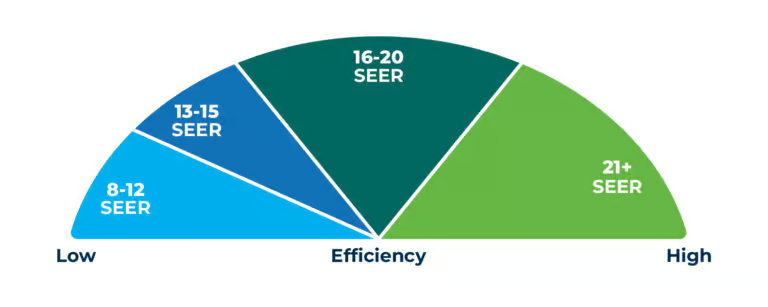
The higher the SEER rating, the more efficiently your system operates. That means:
- You use less energy to cool your home
- You see lower monthly utility bills
- You typically pay more up front for the system
A helpful way to think about SEER is like miles per gallon in a car. A higher number means better efficiency, but that does not always mean it is the best financial choice for every homeowner.
What really matters is how that efficiency translates into your monthly costs.
How SEER Ratings Translate Into Monthly Costs
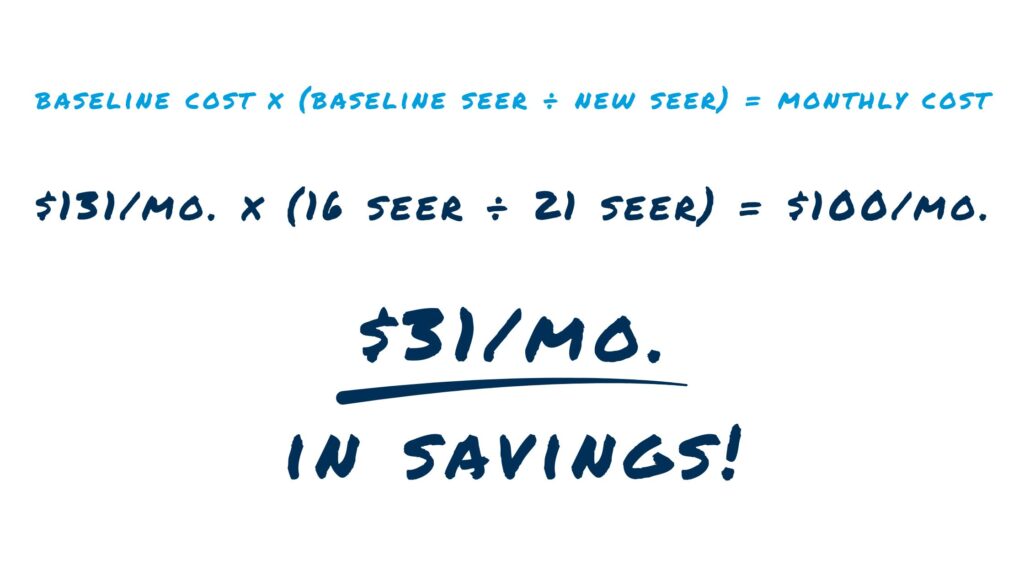
Let’s make this practical. The relationship between SEER ratings and your monthly energy bill might sound like something that’s a pretty vague estimate, but there’s actually a predictable formula you can use to have a better understanding of what your monthly cost might be.
Using data from a SEER comparison estimator, your cooling costs can be estimated with this equation. Here’s an example:
What This Means for You
If you already know what it costs to run one system, you can use that number to estimate how a more or less efficient system will impact your monthly bill.
This is where many homeowners are surprised. Even a small drop or increase in SEER rating can lead to a noticeable difference in what you pay each month.
Comparing Common HVAC SEER Ratings Side by Side
Most homeowners choose between systems in the 14 to 21 SEER range. Here is how those options typically compare in terms of cost, efficiency, and long-term value:
SEER Range | Efficiency Level | Upfront Cost | Monthly Energy Cost | Best For |
14 to 16 | Standard Efficiency | Lower up to $16,000 | Higher | Homeowners not planning to stay in their home long-term |
17 to 18 | Mid-range Efficiency | Moderate up to $20,000 | Moderate to Low | Homeowners planning to stay 5 to 10 years in their home |
19 to 21+ | High Efficiency | Highest up to $30,000 | Lowest | Long-term homeowners or hot climate regions |
What stands out here is how efficiency and cost move in opposite directions. As SEER increases, your monthly energy costs go down, but your upfront investment goes up.
Why Higher SEER Doesn’t Always Mean Better Value
It is easy to assume that a higher SEER rating is always the better choice. But when you look at the numbers more closely, that is not always true.
Diminishing Returns on Efficiency
In the chart below, you can see how monthly cooling costs change as efficiency increases, and more importantly, how the rate of savings begins to level off.
- Moving from 14 to 16 SEER reduces your monthly cost from $150 to $131. A noticeable savings of $19/month
- Moving from 16 to 18 SEER drops costs further to $117/month. A moderate savings of $14/month
- Moving from 18 to 21 SEER lowers costs to $100/month. A $17/month savings, which is slightly higher than the previous step, but still reflects diminishing returns relative to the investment required
While higher SEER systems do continue to save you money, the incremental benefit doesn’t consistently increase.
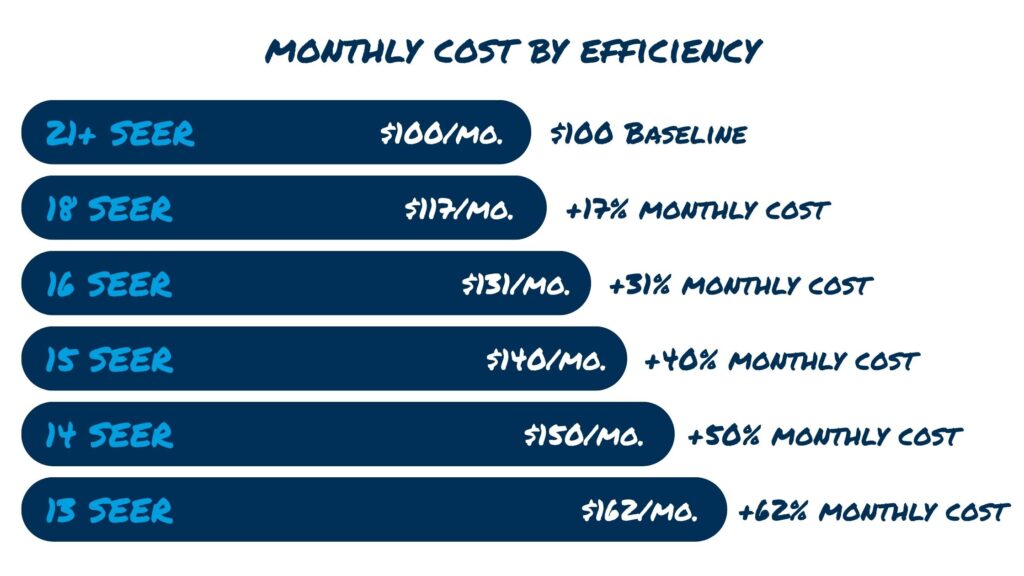
As efficiency increases, new system costs go up, but the additional savings get smaller with each step.
Your Climate Plays a Major Role
Where you live has a direct impact on how much value you get from a higher SEER system.
If you live in a milder climate, your A/C probably runs less frequently, which means your total energy usage is lower and potential savings from high SEER are limited.
If you live in a hotter climate (like our summers get here in Ohio), your A/C likely runs for longer periods, which means your energy usage is higher, and a high SEER system can significantly reduce your monthly costs.
The more you rely on your cooling system, the more valuable higher efficiency becomes.
Your Usage Habits Impact Real Costs
Even with the same SEER rating, two households can see very different energy bills.
Your monthly costs are also influenced by your thermostat settings, the quality of your home’s insulation, and your home’s size and layout.
SEER measures system efficiency, but your day-to-day usage determines how much that efficiency actually saves you.
Other Factors That Impact Your HVAC Costs
Even if you choose the right SEER rating, your monthly HVAC costs are not determined by efficiency alone. Several other factors can significantly influence what you actually pay each month.
System size is one of the most important. An HVAC unit that is too large or too small will run inefficiently, leading to wasted energy and higher costs. Installation quality also matters. A poorly installed system can reduce efficiency and cancel out the benefits of a higher SEER rating.
Your home’s efficiency plays a major role as well. Insulation, windows, and ductwork all affect how hard your system has to work. The more efficient your home, the less energy your system uses. Finally, regular maintenance is essential. Dirty filters and neglected systems lose efficiency over time and cost more to operate.
In short, SEER only delivers real savings when your system is properly sized, well-installed, and supported by an efficient, well-maintained home.
What SEER Really Means for Your Monthly Costs
At this point, you should have a clear understanding of how SEER ratings impact your monthly A/C costs. Higher SEER systems can lower your energy bills, but the real value depends on how long you stay in your home, how often you use your system, and how much you are willing to invest upfront.
If you started this process feeling unsure about whether a higher efficiency system was worth the cost, so do many others. Many homeowners struggle with balancing upfront pricing and long-term savings, especially when the numbers are not clearly explained. Without the right context, it is easy to either overspend or choose a system that costs more over time.
Now that you understand how to estimate your monthly costs and compare savings, your next step is to look at the full financial picture. SEER is only one part of the equation. Installation costs can vary significantly and play a major role in your overall investment.
To get a complete understanding of what you can expect to pay, your next step should be to read our guide on Cost of HVAC Installation with Eco, where we break down real pricing, what impacts your total cost, and how to plan your budget with confidence.
At Eco, we help Ohio homeowners make informed HVAC decisions by focusing on transparency, education, and long-term value. When you understand both your monthly costs and your upfront investment, you can choose a system that truly fits your home and your budget.
FAQs
How long does it take to recoup the cost of a higher SEER HVAC system?
The payback period depends on how much you use your system, your local energy rates, and the price difference between units. In many cases, homeowners see a return within 5 to 10 years, but in milder climates or low usage homes, it can take longer. Running the monthly savings calculation is the best way to estimate your personal timeline.
Do higher SEER systems require more maintenance or cost more to repair?
Higher SEER systems can be more complex, especially if they include variable-speed components or advanced technology. While routine maintenance is similar, repairs can sometimes be more expensive due to specialized parts. However, proper maintenance can help minimize these costs and keep the system running efficiently.
Will a higher SEER rating increase my home’s resale value in Ohio?
In many cases, yes. A high-efficiency HVAC system can be a selling point, especially in markets where energy costs are a concern. Buyers often see it as a long-term savings benefit. However, the added value typically depends on your local market and how recently the system was installed.